PUBLICATIONS & USEFUL LINKS
ARTICLES
CORE ELEMENTS IN COACHING
Regardless of the style or approach or model of coaching, the
following elements provide insight in the generic nature of coaching.
Some of the core elements of a coaching process are:
•
Confidential. The content of sessions with the client i.e. person
or the team being coached
...is religiously guarded;
•
Holistic. No area of a person’s mind, life and work is excluded,
though the person being coached
...determines the area of choice.
•
Developing both inner mastery (mastery of thoughts, states, emotions,
beliefs etc.) and outer
...mastery (mastery of behaviour
and performance in terms of skills, competencies, social and
...work environment, relationships
etc.). As such coaching in the workplace focuses on both
...the “inner game” and
the “outer game” of the person or group.
•
Practical, forward-looking and goal directed around clearly defined
and observable outcomes.
...The process outcomes are not abstract,
intellectual and academic. Outcomes are focused
...on meaningful, observable behaviour
and performance change. As such outcomes are sensory
...based, i.e. seen, felt, heard
etc by the person and others;
•
A conversational (dialogue), cooperative process as a partnership
between the coach and
...an individual or a team or a group;
•
Designed to uncover the unconscious potential and expert competencies
of the person or team
...or group towards optimising these
competencies and overcoming limiting beliefs and behaviours
...(habits) to the benefit of the
person or group;
•
Based on the firm belief and knowledge that:
•
Each individual, team and group has unique and immensely powerful
resources that can and must
...be unlocked and unleashed to live
meaningfully by realising our innate potential for success.
•
The knowledge of how to live or make real the potential that resides
inside the person, team
...or group being coached. The same
applies to the practical solutions towards meaningfulness
...and success in life and work.
•
Meaningfulness and success will only be realised if we want to
change and when we empower
...ourselves to do so.
•
Change is natural and human. Stagnation and remaining “being-stuck”
is unnatural.
Note: The coach does not need to be an expert
in the same field as the person coached, provided only that the
coach can understand the terminology and the jargon used by the
client.

INDIVIDUAL COACHING
Individual Coaching is designed to assist individuals in one-to-one
sessions towards reaching their identified goals in life and work.
In general, coaching benefits anyone who wishes to be the best
they can be in their work or career and live their life as best
and meaningfully as possible. More specifically, our clients benefit
in the following ways:
•
Increased performance at work
•
Meeting personal and organisational bottom-lines
•
Increased clarity of direction
•
Addressing obstacles and hindrances (real or perceived)
•
Increased morale
•
Increased organizational effectiveness and participation in team
work
•
Increased passion and personal drive
•
Improved work-life balance
•
Effective personal talent management and development
•
Improved accountability
•
Improved stress management
•
Improved time management
•
Enhanced self-awareness
•
Improved emotional and social Intelligence
•
Improved sense of meaningfulness in work and/or life
In order to live meaningful lives, have meaningful relationships
and keep up with the competitiveness and the pace of change in
the world at large and in particular in the world of work we need
to discover who we are and how we can be the best at what we do.
Anyone knows that being successful today does not guarantee success
tomorrow. We need to constantly identify better ways of doing
things. The old adage applies: If you want different results,
do things differently and do different things.
It is in the safe space of a coaching session and in the process
as a whole that customised answers are found and solutions are
generated. These answers are found in the most obvious, yet under-utilised
place: inside ourselves and from our own resources. Moreover a
coaching intervention must ensure that solutions are implemented
and where need be refined or changed
A typical coaching contract in an organization would have the
following actors:
•
The sponsor is the person or body taking overall organizational
responsibility for the coaching
...process.
•
The client is the person being coached.
•
The coach is the person facilitating the coaching process.
The success of a coaching intervention depends upon the buy-in
of the sponsor, the client as well as the quality of trust generated
between the client and the coach. Ultimately success of a coaching
process rest on the clarity of compelling outcomes and the successful
implementation of solutions generated.
There are different options for structuring an individual coaching
process:
•
Structured process: a number of sessions or hours are agreed to
upfront
•
Individualised retainer agreement: (especially for executives)
time limitations and the number of
...sessions do not apply
•
Organisational retainer: a coach is paid an agreed retainer to
be used by a selected group of
...individuals or the unit/organisation
as a whole to do short, ad hoc (micro) coaching on a very
...specific outcome at a very specific
moment in time (e.g. preparing to enter an important meeting or
...having to see a potential client).
A reasonable time frame for a structured coaching process comprises
of plus minus six months, generally structured as 12 sessions
of up to 2 hours each. Feedback sessions are scheduled with the
sponsor and the candidate where progress is discussed. The confidential
details which the client does not wish to divulge remains confidential
between coach and client.
Contracts can be renewed or changed.
People find coaching invaluable at various times during their
lives. It is not unusual that a coaching relationship is resumed
a few times during one’s life as the need for it arises.
TEAM COACHING
A team is regarded as a group of individuals who are assembled
(e.g. elected, picked, gathered) with the specific purpose of
achieving mutually agreed goals, albeit on their own behalf and/or
on behalf of others. In the workplace natural teams could be:
Boards, committees, business units, project teams, sales teams,
or even organisations as a whole.
Team Coaching is designed to assist different sizes and compositions
of natural teams in reaching their mutually agreed goals.
Notably, team coaching has to be distinguished from group coaching.
Group coaching takes place whereby a group of individuals assemble
to assist a member or the different members in a group in dealing
with their respective issues or challenges. In this case the resources
(i.e. competencies, experience and expertise) in the group are
combined with an individual’s own innate competencies in
dealing with certain issues. The group has no commonly agreed
goals to achieve other than assisting one another.
Teams encounter difficulties in achieving their goals for a variety
of reasons.
These would include: their goals and outcomes are vague, not
clear, or even worse not known. Sometimes teams under-perform
or individuals in teams under-perform or are not performing at
all. Strategies to achieve goals are often equally vague as the
outcomes are absent or lack greater clarity. Role responsibility
of different members of the team may not be clear. Team cohesion
may be lacking. Communication, leadership, coordination are also
often-found difficulties.
In some cases teams can be very successful but do not know how
to sustain success or how to do even better. They may fall in
the “rut of previous success” and can be oblivious
of their options or become predictable. .
Team coaching can assist teams to overcome many difficulties
in order to accomplish the following:
•
Meeting the bottom-line(s)
•
Clear, compelling, practical, achievable vision, mission, values
and goals
•
Ensuring that the vision, mission, values and goals remain the
constant drivers towards agreed
...goals.
•
Address obstacles (real or perceived) and hindrances (“performance
brakes”).
•
Increase team performance
•
Meeting targets and deadlines
•
Effective role and responsibility management
•
Increased morale
•
Increased organizational and team effectiveness
•
Increased passion and personal drive
•
Improved work-life balance
•
Improved accountability
•
Improved stress management
•
Improved team coherence
•
Enhanced self-awareness
•
Improved emotional and social Intelligence
It has been proven many times over that when we think and act
collectively we are able to achieve better results than when one
individual thinks or works on her/his own or when individuals
act in a fragmented and uncoordinated manner. Furthermore, when
a team is dysfunctional, it affects each individual’s performance
to the extent that the performance of the entire team declines
exponentially.
Interestingly, team coaching sessions often creates a new culture
within the team so that they are able to take the benefits into
their day-to-day interactions with each other, into their own
lives and contexts outside the specific team dynamic. The results
often indicate that an organization and a number of individuals
beyond the team members can reap daily benefits from an investment
into team coaching. Benefits more often than not go beyond the
stated outcomes for a specific team coaching intervention.
The success of any coaching intervention depends upon the buy-in
of the sponsor and of the team as well as the quality of trust
generated and maintained between the team and the coach.
The structure of a team coaching intervention is flexibly customised
from team to team. In some cases the sponsor and/or the organisation
decides on the duration of the intervention as a whole and/or
the number, frequency and duration of sessions. In other cases
the team takes a decision on the duration of the intervention,
the number, frequency and duration of sessions.
The team must ultimately agree on the goals and outcomes.
It is quite likely that individual, one-on-one coaching sessions
related to individuals’ roles and participation in the team
could be required during and or after the intervention as a whole.
Equally, a team coaching session may include moments of group
coaching or have smaller group coaching sessions outside the formal
team coaching sessions.
GROUP COACHING
In group coaching, a group of up to 8 people are coached around
a certain theme or in order to assist a member or members with
their particular challenges. The sessions are facilitated by a
coach. The purpose of group coaching is for members to explore
issues of common interest, explore possibilities, review current
realities, identify obstacles to personal growth and success and
develop practical steps towards change.
Group coaching provides individuals with a wonderful opportunity
to receive coaching while also gaining the benefit from shared
challenges, frustrations, concerns and successes of the other
group participants. Through group coaching you can simultaneously
experience the power of the coaching conversation and the privilege
of group support. It almost sounds like double the coaching at
half the price!
Differences between group coaching and team coaching are:
•
Team coaching pursues a team’s collective and mutually agreed
goals and practical outcomes.
•
Group coaching pursues the participating individuals’ goals
within and through a group dynamic and
...interaction.
Group coaching offers the following opportunities:
•
form a network to deal with issues of common interest and to support
you in your development
•
focus on important goals and priorities
•
discuss concerns and solutions
•
tap into the collective genius of others
•
support, belonging, synergy, inspiration, increased awareness
and feedback
•
learn how to express and manage anxiety, sadness, anger, stress
and pain
•
individual coaching during group sessions
•
increased mastery of own coaching skills as you support and coach
other group members
Group coaching is for people who:
•
are committed to personal development
•
want to explore specific topics and diverse views within the context
of a group
•
are willing to support and provide privacy and safety when others
share what truly matters to them
•
are ready to move outside their comfort zone
•
want to reach or exceed their goals
Even people who prefer to listen and observe, rather than to
talk or participate benefit from group coaching. They might discover
that they have a lot in common with other group members and thereby
learn a lot about themselves. Group coaching also increases awareness
of individual issues that the person may previously been unaware
of.
The groups are small, between 5-8 people, and are designed to
be interactive and to create a supportive learning environment
in defined topic areas. Discussion of those actions, coaching
through artful questioning, guiding and supporting forms an integral
part of the group coaching process. The synergy and growth takes
place through what the participants bring to the group. Participants
constantly raise the standards by challenging each other to create
and implement goals.
The nature of group coaching is relationship-based and intense,
and commitment of a period of e.g. 3-6 months is required. Group
size is limited to ±8 participants so that everyone can
get personal attention.
In group coaching each member is separately honoured and valued.
People join coaching groups with the intention of receiving personal
value and achieving specific goals. When such individuals join
together to become a coaching group the magic happens where reciprocity
and generosity create greater value than ever imagined.
In group coaching the participants take ownership of the process.
It is not a training workshop where the facilitator determines
what information and content is taught. The coach takes his/her
cues from the group, the group determines the agenda and individual
participation is key. Peers give each other feedback, help brainstorm
new possibilities, and set up accountability structures to keep
them focused and on track.
COACHING AND OTHER ORGANISATIONAL INTERVENTIONS
Different individuals and organisations use terminology related
to coaching in different ways. This is partly due to the fact
that coaching in the workplace is a fairly recent development
in South Africa.
In work situations the term “coaching” is often interchangeably
used with reference other human resource or organisational interventions
such as “training”, “mentoring”, “counselling”,
“consulting”, etc.
Coaching is regarded as a markedly different process in terms
of the relationship between coach and coachee, as well as the
structure and purpose of the process in comparison to interventions
such as training, counselling, mentoring and consulting. This
differentiation casts no aspersions on the value and meaningfulness
of other human resource-related interventions in the workplace.
Neither are any of these interventions, coaching included, a panacea
for all situations. In fact these different interventions could
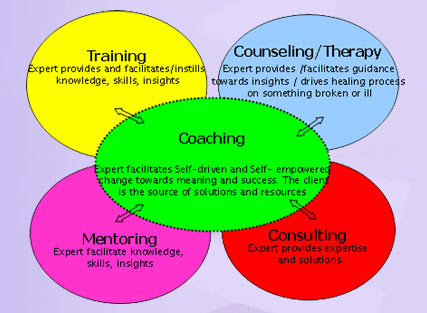
be utilised in conjunction with a coaching intervention as indicated
in Fig 1.
A coaching intervention may have moments and elements of counselling,
mentoring, and consulting and or may display some results in those
fields. A person may, for instance, develop insights in personal
difficulties; a person may acquire knowledge from a coach who
may be particularly knowledgeable and experienced in a particular
field of expertise; the odd occasion may arise that the coaching
session may include the receiving of advice. Furthermore the coaching
process may indicate that the client may have serious need for
mentoring our counselling or may have to see a medical doctor.
The coaching process can accommodate and cooperate with such
services and persons providing such services. Moreover, the nature
of the coaching process is such that the choice of additional
service and the decision for its accommodation resides with the
person, team or group being coached.
Herein is the main difference between coaching and other human
resource interventions, namely: the person being coached is the
expert in his profession and life. The coaching relationship is
one of a partnership in assisting the person to clarify and achieve
her/his (including a team or organisational) goals.
ASSESSMENTS IN THE COACHING CONTEXT
The assessments conducted or facilitated in the context of a
coaching process are purely aimed at enhancing the personal development
of the client. (It is, for example, not aimed at finding the right
person for a position such as during recruitment and selection
purposes).
An assessment is not a quick-fix, nor does it provide an instant
solution to people’s problems. Assessments are aimed at
raising self-awareness, i.e. personal and interpersonal awareness.
It provides insight into your own strengths, challenges, beliefs
about self and others and behavioural styles and enhances the
impact of personal learning and development through coaching.
It also helps people to understand the way they see and interpret
the world around them and opens up possibilities for different
ways of looking at their own behaviour and the behaviour of others.
Personal development must be needs-based. As a result assessments
may assist an individual or a team in making choices and taking
decisions regarding their own development and ensures that these
needs are accurately identified and addressed. It provides the
context and background for the formulation of individual and team
development targets and helps us to evaluate progress and manage
the achievement of goals.
A wide variety of assessment tools and instruments are available.
In cooperation with the client the most suitable instrument is
selected, based on individual requirements and expectations, development
needs and potential contribution of the assessment to the development
process.
On completion of an assessment detailed feedback is provided.
Insights gained by the candidate are used as an input (not prescription!)
in the development process. The assessment assists the client
to design a personal development plan or to determine the future
focus of a coaching relationship.
Assessment in the development context is never aimed at boxing
or labelling people. It is aimed at raising awareness to enable
us to explore new possibilities for personal and interpersonal
growth.
Assessments could be done at various stages of a coaching process.
•
Prior to a coaching intervention. The assessment would assist
in developing clear outcomes for the
...coaching process.
•
During a coaching process. In that case, the information is used
to monitor progress and to refine
...or even change outcomes.
•
At the end of a coaching process. The information is used to determine
the success of the process
...and could determine further work
that could or should be done.
Each coaching process should normally start with some (albeit
it a robust and basic) form of assessment, as a way to start reflection
and to start the discussion on coaching and its outcomes.
The nature of the assessment and the choice of the instrument
are determined by factors such as the needs of an individual or
team, the complexity of issues faced and finally by financial
considerations. Some instruments can only be used by persons (e.g.
psychologists, therapists) specifically qualified to take down
information, process information and provide a report and/or debrief.
ASSESSMENT INSTRUMENTS - THE ADFEN E-SCALE
(ENNEAGRAM)
The Adfen E-Scale is an assessment and development instrument
used in Personal, Executive, Management, Leadership and Team Development
processes. It was developed by a team of experienced coaches,
facilitators & psychologists and presents immediate, detailed,
written reports online which are debriefed with clients: individuals
and/or teams
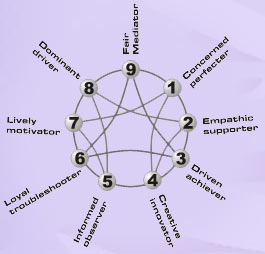
The instrument is based on the Enneagram model of human behaviour
- a powerful and dynamic diagnostic system of human behaviour.
The Enneagram describes nine structures (“interrelated
patterns”) of human behaviour styles and viewpoints.
Each “pattern” provides information related to interpretation/viewpoints,
strengths and areas of development in a person’s behaviour
patterns.
Most people have built a life strategy around one of the nine
viewpoints and the Enneagram provides a framework for understanding
your own behaviour: in relation to other people; specific personal
and interpersonal strengths and challenges, and; creates possibilities
for maximising our full potential.
A simplified and generalised overview of the nine different behaviour
styles:
One: Conscientious, purposeful, responsible
& precise
Two: Warm, affirming, compassionate & nurturing
Three: Efficient, motivating, goal-orientated
& industrious
Four: Intuitive, refined, distinctive & introspective
Five: Observant, innovative, logical & objective
Six: Loyal, responsible, cautious & tenacious
Seven: Enthusiastic, visionary, gregarious &
spontaneous
Eight: Assertive, autonomous, decisive &
fearless
Nine: Patient, reassuring, easy going & diplomatic
The Adfen E-Scale has been used in different cultures (USA, UK,
South Africa, Jamaica and Poland), different industries and contexts
and as part of various development interventions – coaching,
counselling, training and development.
The immediate and practical insights gained by clients into their
own strengths and potential areas for development makes this a
simple yet powerful tool to enhance any development initiative.
TRAINING PROVIDED BY COACHING SOUTH AFRICA
THE MANAGER AS COACH (part 1)
This article outlines the current realities that necessitate
coaching in the workplace - the most successful way to improve
the skills and performance of every employee.
For most managers Performance Management and Performance Appraisal
or Review is regarded as synonymous. They dread the preparation
time it takes and the fact that bad news has to be conveyed. In
many instances they can also not understand that the reprimand
for poor performance comes as a surprise to the subordinate. The
Critical Performance Indicators (KPIs) or performance objectives
of the team and individuals are seldom aligned with tactical and
operation goals, the mission or strategy of the organisation.
Even when they are linked in the manager’s perspective,
the team members are seldom aware of the direct contribution their
performance makes to the achievement of the organisational goals.
In addition to these frustrations the management of performance
is mostly seen as the accountability of the manager or team leader
with individuals not assuming their responsibility.
Traditional classroom training has limited impact on skills transfer,
personal development and organisational growth. In many instances
the training is not needs-directed or outcomes based and limited
integration of new skills takes place in the workplace. Managers
often do not support team members in applying or trying out new
skills. The link between skills development and on-the-job performance
is often not clear to the individual that attended the training.
In addition to this the Human Resource Department is blamed for
incompetent workers and the lack of suitable training.
In view of these realities, how does the manager then handle
the problem of skills deficiencies and inadequate performance
in the workplace? By telling people what to do and how, doing
the job themselves, refraining from delegating and giving solutions
to all the problems. They keep team members dependent on them
and never empower them to solve their own problems.
When a problem is raised the manager’s first reaction is
to give the solution. Responsibility is not shared and no personal
development takes place. The aim of coaching is to get team members
involved in seeking solutions, not hiding problems or reporting
problems and asking for solutions, instructions or advice. The
first step towards coaching team members is to give fewer solutions
and ask more questions. By asking questions the manager involves
the subordinate in finding the solution and the responsibility
for successful implementation of the solution is shared. This
result is better teamwork and shared learning. Listening, observation
and feedback are, in addition to questioning, some of the most
important skills required for successful coaching in the workplace.
Every manager who meets his/her responsibility for improved performance
and skills development through coaching will be rewarded in tangible
and intangible ways: the achievement of operational objectives,
continuous improvement, increased job satisfaction, high team
morale, improved relationships, motivated team members and the
growth of individuals and the team.
EXECUTIVE BRIEFING: THE BUSINESS IMPACT OF
LEADERSHIP COACHING AT A PROFESSIONAL SERVICES FIRM.
Copyright MetrixGlobal, LLC www.metrixglobal.net 2
Prepared by Merrill Anderson, Ph.D.
MetrixGlobal, LLC
April 2004
The Leadership Centre of this professional services firm provides
executive development solutions to the partners and principals.
One such solution, the executive coaching program, enabled leaders
to quickly engage with an executive coach to accomplish development
goals.
The Centre was interested in enhancing the utilization of coaching
and engaged MetrixGlobal, LLC in order to better understand how
people applied what they gained from coaching to create intangible
and monetary value for the business. Staff members from MetrixGlobal,
LLC and the Centre personally interviewed each leader to understand
what they learned from coaching, how they applied what they learned
to the work environment, and the impact that these actions had
on the business.
1. 55% of the leaders worked with a coach for
nine months or less and 45% worked longer with a coach; 25% working
with a coach for over a year.
2. The main competencies that coaching assisted
leaders to develop included:
...a. Leadership
behaviour, cited by 82% of the respondents
...b. Building teams,
cited by 41%, and
...c. Developing
staff, cited by 36%.
...d. Less frequently
cited were developing leaders (23%), client and market development
(14%), ........business
management (5%) and leadership in professional industry community
(5%).
3. The leaders were very satisfied with their
coaching experiences:
...a. 86% rated
coaching as very effective
...b. 95% are doing
things differently as a result of coaching, and
...c. 95% would
recommend coaching to other Company staff.
The results indicated that all leaders readily applied what they
gained from their coaching experiences to make significant strides
in self-development while over half (53%) of the respondents went
even further to make significant improvements in their relationships
with peers and team members. Some (18%) of the leaders even went
on to significantly improve client relationships; gaining greater
clarity about how their behaviour impacted clients and being better
able to respond to client issues.
Senior leaders identified eight business areas that they expected
executive coaching to impact.
…of these eight areas, two were cited as being especially
impacted by at least half of the leaders who were coached:
Teamwork (58%) and team member satisfaction (54%). Three other
areas were selected by 31% of the leaders as having been impacted:
quality of consulting, retention and productivity. Accelerating
promotions (19%) and increasing client satisfaction (12%) were
cited to a lesser degree.
Only one leader (4%) credited coaching with increasing diversity.
Monetary benefits were rigorously documented, isolated from other
potential influencing factors and discounted for error of the
estimate and other factors. The total monetary benefits were $3.3
M with four impact areas each producing at least a half million
dollars of annualized benefit to the business: improved teamwork
($981,980), quality of consulting ($863,625), retention ($626,456)
and team member satisfaction ($541,250). Factoring in the fully
loaded cost of the coaching (including opportunity costs, or the
time leaders spent being coached), the ROI was 689%.
The Bottom-Line
Coaching has positively impacted the ability of leaders to build
competencies and deliver bottom-line value to the business. While
all competencies were positively impacted, leadership behaviour,
building teams and developing staff were especially improved.
The data suggest that building these competencies led directly
to positive impact on the business. Teamwork and team member satisfaction
were the top business impact areas cited by leaders.
Combined, these two areas alone produced over $1.5 M in annualized
benefits. Better integrating executive coaching as a centrally
managed initiative with other corporate human resources initiatives
and development activities could potentially further accelerate
building the required competencies.
The very positive ROI for coaching indicates that any further
investment in coaching will more than pay for itself. The focus
of decision-making regarding the future of coaching should shift
from just what the cost of the coaching would be, to focus on
the kind of value that coaching can provide to the business.
ROI and Learning Evaluation, Leadership Coaching and Consulting
MetrixGlobal, LLC is a consulting and leadership coaching company
dedicated to improving the performance of people and organizations.
We create sustainable value and bottom-line results through our
ground-breaking work in learning evaluation, leadership coaching
and ROI studies. Whether we are working with an individual or
an entire organization, we take an insightful approach to creating
strategic change. Our award winning work has been conducted with
clients in over twenty-four countries.
Please visit www.metrixglobal.net
to learn more about the firm.
NOTE: Metrix Global has changed name to Cylient
and can be viewed at www.cylient.com
Editor: Coaching South Africa.
EXECUTIVE BRIEFING: CASE STUDY ON THE RETURN
ON INVESTMENT OF EXECUTIVE COACHING
Prepared by Merrill C. Anderson, Ph.D.
CEO, MetrixGlobal, LLC
Copyright MetrixGlobal, LLC. All Rights Reserved. www.metrixglobal.net
A Fortune 500 firm and a coaching services company, recently
engaged MetrixGlobal LLC to determine the business benefits and
return on investment for an executive coaching program. This executive
briefing was excerpted from the final report of the study and
is intended for the private use of MetrixGlobal clients and professional
associates. Please contact Merrill Anderson, merrilland@metrixglobal.net,
515 278-0051, for additional information.
The Bottom Line:
Coaching produced a 529% return on investment and significant
intangible benefits to the business. The study provided powerful
new insights into how to maximize the business impact from executive
coaching.
Introduction
A Fortune 500 firm launched an innovative leadership development
effort that was expected to accelerate the development of next
generation leaders. The participants in this effort were drawn
mostly from the ranks of middle managers and from many different
business units and functional areas. Leadership development activities
included group mentoring, individual assessments and development
planning, a leadership workshop and work on strategic business
projects.
Coaching was considered to be a key enabler for this approach
to leadership development because the participants could work
privately and individually with his or her coach to develop specific
leadership competencies. The client organization engaged the Coaching
services company to provide coaching to the leadership development
participants. While participants spoke very highly of their experience
with coaching it was decided to conduct a formal assessment of
the effectiveness and business impact of coaching. It is intended
that the results from this study be used to determine:
1. How did coaching add value to the business
and what was the return on investment?
2. How could coaching be best leveraged in the
future, especially if coaching was to be expanded
... to other business
regions?
Data Collection Procedures
It was decided that the best way to isolate and capture the effects
of coaching on the business was through a questionnaire. This
questionnaire had two parts. Part one was completed electronically
via email and examined clients initial reaction to coaching, what
they learned, how they applied what they learned and captured
their initial assessment of business impact. Part two was conducted
over the telephone with each respondent and probed more deeply
into business impact and the financial return on investment.
The target population for the survey was 43 leadership development
participants. These participants were drawn from two regions:
Eastern United States (37) and Mexico (6). These participants
represented a cross section of the business and included those
in sales, operations, technology, finance and marketing. All had
been identified as potential leaders and executives. Thirty (30)
of 43 leadership development participants returned their surveys
for a 70% response rate.
Results
Coaching was a very effective developmental tool for the leadership
development participants, producing financial and intangible benefits
for the business. Coaching sessions were rich learning environments
that enabled the learning to be applied to a variety of business
situations. Decision-making, team performance and the motivation
of others were enhanced. Many of these business applications contributed
annualized financial benefits. Other applications created significant
intangible benefits. Overall, the participants appreciated their
coaching experiences and would highly recommend coaching to others.
Three-quarters (77%) of the 30 respondents indicated that coaching
had significant or very significant impact on at least one of
nine business measures. In-depth discussions were conducted over
the telephone with each respondent to further explore the business
impact of coaching. Sixty percent of the respondents were able
to identify specific financial benefits that came as a result
of their coaching.
Overall, productivity (60% favourable) and employee satisfaction
(53%) were cited as the most significantly impacted by the coaching.
Respondents defined productivity in this context as relating to
their personal or to their work group productivity and half (50%)
documented annualized financial benefits. Employee satisfaction
was viewed both in terms of the respondents being personally more
satisfied as a result of the coaching as well as the being able
to increase the employee satisfaction of their team members. The
respondents could not quantify this benefit in financial terms.
Employee satisfaction, then, was a significant source of intangible
benefits. Customer satisfaction (53%) was also a significant source
of intangible benefits.
The next most frequently cited as being significantly impacted
by coaching were work output (30%) and work quality (40%). Twenty
percent of the respondents identified financial benefits as a
result of increased work output. Many respondents reported improvements
in work quality, however, they were not able to quantify these
improvements in terms of dollar benefits. Work quality improvements
were considered an intangible benefit of the coaching.
Program costs were tabulated for all 43 leadership development
participants in determining the return on investment. A 529% return
on investment was produced by the coaching process (excluding
the benefits from employee retention). While those clients who
had customer or people responsibilities produced proportionally
greater financial benefits, the realization of benefits to the
business was fairly widespread throughout the group involved in
this study.
Recommendations were made to maximize the business benefits from
executive coaching:
Manage the entire coaching process to ensure consistency and
quality. Though the content of individual coaching sessions should
always be confidential, the coaching process itself needs to be
managed to ensure that the coaching clients and the coaches are
following the appropriate process and leveraging best practices.
Prepare clients in advance for coaching and don't force coaching
on anyone. Because coaching remains a relatively new development
technique, people may not understand how the coaching process
can help them become better business professionals. The sooner
they understand the process, the sooner they will see results.
Offer clients the ability to select their coaches. Chemistry
is important to build an effective coaching relationship. Provide
prospective coaching clients with information about the coaches
including biographies, education, coaching credentials, functional
expertise, industry experience and other background information.
Provide coaching strong organizational support. Those being coached
should receive encouragement and support from their immediate
managers. Also, coaching should be conducted in the context of
other developmental efforts such as competency development, assessments,
mentoring and leadership workshops.
Ensure coaches are grounded in the company’s business and
culture. Coaches are more effective when they can identify with
and talk about the realities of their client's environment.
Allow each coaching relationship to follow its own path. A major
difference between coaching and training is that coaching allows
the individual to determine what works best for him or her at
a very personal level. Coaches need wide latitude to work with
“the whole person” and help each client be more effective
as a person as well as to be more effective as a business leader.
Build performance measurement into the coaching process. Evaluation
of coaching should be designed into the process from the beginning
to better set performance expectations and open up new learning
opportunities for making coaching more effective while the coaching
is being conducted. For example, coaching can be refocused to
deal with issues or to ensure that business priorities will be
met. In this way, the evaluation of coaching becomes more than
just a measuring stick – it becomes a structured approach
to deepen the business value of coaching.
MetrixGlobal, LLC is a consulting and leadership
coaching company dedicated to improving the performance of people
and organizations. We create sustainable value and bottom-line
results through our ground-breaking work in learning evaluation,
leadership coaching and ROI studies. Whether we are working with
an individual or an entire organization, we take an insightful
approach to creating strategic change. Our award-winning work
has been conducted with clients in twenty-four countries.
GAYS AND LESBIANS: UNLEASH YOUR POTENTIAL
AT WORK AS WELL
More and more nowadays, executive directors, managers and professionals
in various fields use coaching as a way of enhancing the chances
of success in setting up and/or growing their businesses as well
as improving their performance.
The debate is over in South Africa – coaching improves
productivity, effectiveness and efficiency by a measured 22,4%
( “Over to you, coach” by Bill Price, Mail and Guardian
Mail & Guardian, May 27 to June 2, 2005).
But it’s also increasingly clear, to coaches and their
clients alike, that productivity, etc. are of a piece not just
with issues of leadership, management competencies and career
path planning, but also with health, family relations, spirituality,
values and personal growth.
Gays and lesbians, regardless of their line of work or position,
are constantly up against decisions related to sexual orientation.
These decisions affect almost everything from the fact of having
a job at all, to one’s effectiveness and career progress.
The scenarios are well known. For example:
A top accountant who happens to be gay is being interviewed for
a job. All is plain sailing until the final, innocuous question:
Is there anything else that you think we should know or take note
of? The candidate thinks: If I tell them I’m homosexual,
it could blow my chances of a promising career. If I say nothing
and it comes out later, will it be an issue? Will I be accused
of having lied to get the job?
A young man decides to come out of the closet. As a candidate
attorney at a big law firm, he knows there will be consequences
in terms of his effectiveness and professional relations with
colleagues and superiors. These in turn may impact on his career
as a whole, let alone with the firm. His entire life, in fact.
Then there’s the professional person who has worked through
being lesbian and lives with her lover, but doesn’t want
her colleagues to know that she, the managing director, is homosexual;
she’s always on her guard. One day she tells the HR department
she is taking time off to be with her friend who is critically
ill in hospital. The HR person asks: Why should you be at the
hospital if your friend has her close family nearby?
Many businesses and careers have been ended or seriously damaged
when people’s sexual orientation became known either because
they themselves declared it or for reasons beyond their control.
We all know at least one sad story – such as that of the
beloved small-town doctor who is also a respected church elder
and chairman of the sports club, and turns out to be gay.
A professional sportsman or politician reaches the peak of his
career or reaches retirement age: Where to next? Is there a different
level or direction for me? Could this be the time to declare that
I am homosexual?
All these are instances of where the right coach could be invaluable.
Trustworthiness and skill are of small use, however, if gays and
lesbians themselves suppress issues and keep them out of coaching
processes.
Fear is a factor. Fear of consequences and the environment. If
I talk to a coach about my being gay, I will be forced to come
out in the open here. No way! I am not ready for that! It will
only be a career-limiting move. Linked to this is fear of the
unknown. Will I lose clients when it emerges that I am gay? Will
I still be respected? A person with inner thoughts such as I am
lesbian and these people will just never appoint me and may simply
give up and not apply.
Some homosexuals, finding themselves repeatedly stuck in dilemmas,
reach a point of saying: I am sick and tired of acting straight.
I don’t feel free. I believe I can do much, much better
if I am free. But they too can’t see any solution.
People like Mixael de Kock (in: Homosexuality and Achievement,
Gay Pages, winter 2005) and Rubin van Niekerk (in: Gays are an
Asset for South African Business, Sunday Times, May 6, 2007) provide
convincing cases that gays form part of successful business –
gay-driven and otherwise – and make a positive economic
contribution. That is apart from being exemplary in this regard.
Sadly, however, not everybody’s potential is unlocked or
unleashed. Self-limiting thoughts and beliefs about being gay
or lesbian in the workplace remain untested and unchallenged.
Personal, professional or career growth is curtailed; opportunities
are missed.
Coaching is about bringing true potential out of the closet.
It’s about helping a person to further a career, to seize
opportunities or further develop skills such as time management
or interpersonal relations. It could involve basics of mindset
and behaviour and how to change them for the better. I need to
be able to say what I think and feel in meetings or to my partner,
instead of just keeping quiet.
Coaching, be it at work or private, doesn’t take place
because there’s something wrong. Rather, it deals with what’s
right, i.e. the person or team wanting to do better or differently.
Coaching facilitates positive change.
Positive change usually starts with identifying the stuff that
holds us back, such as the fact of being logical and good with
figures but unable to work well with people. It’s about
recognising who we are and our unlimited (yes, unlimited) potential.
Awesome! I am not just gay. Being gay is just my sexual preference.
I am a full person. I am going to live this person.
Coaching may be a one-on-one process either at the workplace
or in private, face-to-face or telephonic. It could also be a
team event, e.g. a series of sessions for a Board or a business
unit to reach strategic and business objectives. In all instances,
however, it’s about helping people to take their own decisions,
make their plans, and develop their own process for implementing
them. They learn the importance of taking responsibility for failures
and credit for successes in creating new and different futures.
And that everybody is entitled to respect – worthy of acknowledgement
for what they know, and for knowing what’s best for themselves.
Good coaching is not about training for new knowledge, skills,
and competencies. It doesn’t provide prefabricated, one-size-fits-all
advice, perspectives, or options or – worse yet –
impose such advice, perspectives or options. It doesn’t
dig into the past unless the person wants that, or make diagnoses,
or deal with what is wrong, ill, or broken or regarded as wrong,
ill or broken. Nor does the need for coaching mean that the person
or team lacks what it takes to do what has to be done.
Most people have all that it takes. They just don’t always
realise it. They need to be in touch with their strengths –
including those that may reveal themselves for the first time
during the coaching process – and use them as resources.
Life begins at the end of our comfort zones, especially the comfort
zones that actually are uncomfortable.
THE MANAGER AS COACH
Managing a coaching intervention in your organisation and Establishing
a coaching culture
The Manager as Coach focuses on honing the crucial
skill of being able to coach, for staff in managerial positions.
Modern business requires leadership styles that encourage cooperation,
empowerment, problem-solving and inspiration, to name but a few
of the abilities that a coaching leadership style demonstrates.
Management development is often a high priority on a learning
organisation's agenda. It equips staff with the basic competencies
in areas such as Planning, Organising, Leading and Control. These
competencies, however, do not deliver the required and sustained
results on their own and in isolation. The people in the organisation,
the people component ,seem to be sorely missing in basic management
training. Equipping staff with listening, questioning, feedback
and facilitation skills are some of the outcomes to be expected
in the Manager as Coach training and will prove invaluable to
your organisation.
Managing a coaching intervention assists human
resource centres and line managers with developing, implementing
and ultimately reviewing integrated coaching interventions. The
training will provide attendees with the ability to identify processes
for establishing :
•
the purpose of coaching e.g. developmental, as a retention strategy,
for succession planning
•
criteria for choosing coaching candidates
•
coaching goals and defining success
•
choosing coaches and setting up contracts / Service Level Agreements
•
organisational and individual expectations
•
alignment with corporate strategy and focus
Establishing a coaching culture deals on a strategic
level with a core enabling factor for organisational success,
namely organisational culture. How is “What we are going
to achieve” supported by “How we intend achieving
it through our people”…the published and the unwritten
version. COACHING SOUTH AFRICA will assist organisations with
the
•
diagnostics (what companies belief their culture to be and what
the people say),
•
“walk the talk” and “reward the talk”
- alignment with performance measurement
•
Implementation, especially strategic alignment
•
setting up of coaching groups/teams within the organisation and
•
review processes of their success measurements and further development
requirements
USEFUL LINKS
Information on ROI in coaching and other areas of human resource
and organisational development
www.metrixglobal.net
The Pyramid Resource Group conducted the study on the ROI in Executive
Coaching
www.pyramidresource.com
|